Hel
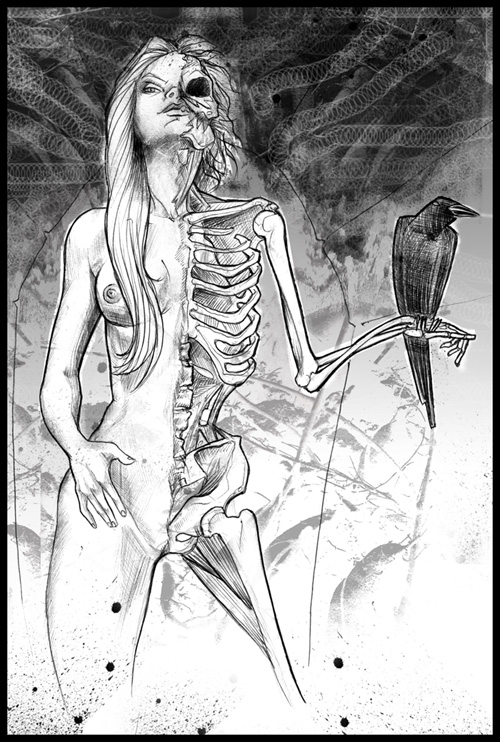
Who?:
The daughter of the trickster-god, Loki. Youngest of three children, sibling of Fenrir and Jormungand. Despite her role and/or appearance, she is considered to be disinterested in fighting and/or combat. Instead, she uses her focus to maintain balance between life and death.
What?:
Goddess of death and of the underworld. Overseer of dishonourable souls that are cast to Helheim. A very powerful deity, could be considered the most powerful in Norse mythology. She appears in the form of a woman on one side of her body, and the other side being a much darker, zombie-like figure. She has the power of controlling death, corpses and such like. She is the soul sole judge of whether or not a soul will be carried into Valhalla, or instead taken into her (not so loving) embrace.
When?:
The name Hel, which is also the name of the region that the Goddess resides in, is taken from Proto-Germanic (old version of modern English). Similarly, Christian missionaries to the Anglo-Saxons used the word ‘Hel’ or ‘Helle’ to describe the Underworld, and so Old Norse scripture used this word, because it was the closest associated description. It’s important to realise that the Norse Hel is a completely different place to the Hell described in Christianity.
Story:
When Odin found out that Loki had fathered children, he sent the gods to find them and bring them to him. Odin was afraid, so when the gods brought the children to him, one of them being Hel, he assigned her to rule over seven Kingdoms, one of them being Helheim.
When Hel was first establishing her power in the Underworld, the beast Gamr (child of Typhon and Echidna) met with her. Initially, Loki feared that the beast would devour Hel, but Hel tamed the beast and used it to help her guard the realm.
A well-known story involving Hel also involves the god Baldr (who was violently killed by Loki). The story involves Baldr being sent to Helheim (and consequently Hel), who was surprisingly treated quite well by Hel. She catered to his needs and mostly left him alone. They had a neutral relationship, but bonded occasionally, as far as they could with their very obvious differences, Baldr representing all things light, and the other representing the darkness.
Hermodr was sent to retrieve Baldr from Hel, and Hel agreed to hand over Baldr, on one condition: if every living and dead thing in the Universe mourned for Baldr, then Hel will free him. But, unfortunately, Loki did not mourn, which meant that Baldr remained.
Hel and Baldr, grew to become very close. They did the making babies thing and produced Krampus.
In conclusion, Hel was feared by most. Including the Dark Prince Mundus, who seeked to accumulate more power by requesting that Hel join the souls within her kingdom(s) with his. Hel declined because she didn’t trust Mundus (smart). She assumed that he’d backstab her with the first chance that he’d get. Mundus kept a wide birth from her after her rejection, proving to the level of her power.
Pro Tip:
Definitely swipe left on Tinder should you be matched with this broad.
References:
Image Credit: Tara Ryzebol (link: https://commons.wikimedia.org/wiki/File:Hel.jpg)
https://norse-mythology.org/cosmology/the-nine-worlds/helheim/
 Stolen Grace
